
Molecule building
Jun 2, 2010
at
8:10 PM
Today's class consisted of an activity to build molecules with the kits Mr. Doktor gave us. After dividing ourselves into groups of 2 or 3, the race begun.
|
0
comments
|

Esterfication Lab
May 27, 2010
at
7:58 PM
In today's class, we created a smell in our Esterfication lab. My group chose
Here's a quick review if you do not remember how Esterfication works:
Here's a quick review if you do not remember how Esterfication works:
|
0
comments
|
Amines and Amides
May 20, 2010
at
8:12 PM

Amines:
end in -amine after the alkyl prefix
have a double bonded oxygen to the carbon chain and NH2 connected to the carbon chain
Name the following:

Answers:
1. ethanamide
2. methanamide

Amides:
end in -amide with the carbon prefix
have possibilities of primary (one carbon chain), secondary (two carbon chains), or tertiary (three carbon chains) chains connected to nitrogen
Name the following:


Answers:
1. dimethylamine
2. methylamine
|
0
comments
|
Aldehydes, Carboxylic Acids, Esters & Esterfication
at
12:01 PM
ALDEHYDES
Naming: change the -e ending to -al

Ex. Draw Methanal (formaldehyde)

Ex. Benzaldehyde

CARBOXYLIC ACIDS
Naming: change the ending to -oic acid

Examples:

ESTERS
Naming: the primary chain has the -yl ending and the secondary chain takes the -oate ending

Examples:

ESTERFICATION
Always has H2O

Check out this website for some help!
http://www.ausetute.com.au/esters.html
Naming: change the -e ending to -al
Ex. Draw Methanal (formaldehyde)
Ex. Benzaldehyde
CARBOXYLIC ACIDS
Naming: change the ending to -oic acid
Examples:
ESTERS
Naming: the primary chain has the -yl ending and the secondary chain takes the -oate ending
Examples:
ESTERFICATION
Always has H2O
Check out this website for some help!
http://www.ausetute.com.au/esters.html
|
0
comments
|
Functional Groups
May 18, 2010
at
9:07 PM
Halides:
-halogen atoms replace a hydrogen: Bromo, Chloro, Floro
EX. 2,2, dibromo 3 chloro, 1,3 difloro propane

Alchohols:
-OH or hydroxyl group
-change the ending to -ol
EX. 3 floro 2 methyl 4 pentaol

Ketones:
-oxygen atom doubled bonded to carbon
-change the ending -one
EX. 2 propaone (acetone)

Ethane:
-have an O joingin the two carbon chains together
-name carbon side chain with -yl ending and add 'ether'
EX. diethyl ether

-halogen atoms replace a hydrogen: Bromo, Chloro, Floro
EX. 2,2, dibromo 3 chloro, 1,3 difloro propane

Alchohols:
-OH or hydroxyl group
-change the ending to -ol
EX. 3 floro 2 methyl 4 pentaol

Ketones:
-oxygen atom doubled bonded to carbon
-change the ending -one
EX. 2 propaone (acetone)

Ethane:
-have an O joingin the two carbon chains together
-name carbon side chain with -yl ending and add 'ether'
EX. diethyl ether

|
0
comments
|
Alkenes & Alkynes
May 4, 2010
at
4:55 PM
ALKENES
- compounds with double bonds end in -ene
- a number in front of the parent chain tells where the double bond is
- more than 1 double bond changes the parent chain slightly
ALKYNES
- for compounds with triple bonds, use the -yne ending
- follow all the same alkene rules
Here's a quick recap:
And for some practice, check out this worksheet:
Organic Chemistry (with answers)
- compounds with double bonds end in -ene
- a number in front of the parent chain tells where the double bond is
- more than 1 double bond changes the parent chain slightly
ALKYNES
- for compounds with triple bonds, use the -yne ending
- follow all the same alkene rules
Here's a quick recap:
And for some practice, check out this worksheet:
Organic Chemistry (with answers)
|
0
comments
|
Organic Chemistry
Apr 30, 2010
at
3:01 PM
- there are more carbon compounds than all ionic compounds combined
- the study of carbon compounds is organic chem
- carbon can have multiple bonds and form many different shapes
Hydrocarbons have 3 types of formulas:
- molecular formulas (C6H14)
- condensed structural formula (CH3-CH2-CH2-CH2-CH2-CH3)
- structural formula

Nomenclature of Hydrocarbons
- One molecular formula can have a number of different structures
- Isomers are compounds that can be drawn in more than one way
How to name alkanes
1) Add "ane" to the longest chain with the correct suffix
2) Locate any branches by number carbon atoms (with the lowest numer)
3) Name branches with the appropriate suffix and -yl ending (Alkyl branches)
4) If there are more than one of the same alkyl group, number each one and add the multiplier number in front of the branch name

- the study of carbon compounds is organic chem
- carbon can have multiple bonds and form many different shapes
Hydrocarbons have 3 types of formulas:
- molecular formulas (C6H14)
- condensed structural formula (CH3-CH2-CH2-CH2-CH2-CH3)
- structural formula
Nomenclature of Hydrocarbons
- One molecular formula can have a number of different structures
- Isomers are compounds that can be drawn in more than one way
How to name alkanes
1) Add "ane" to the longest chain with the correct suffix
2) Locate any branches by number carbon atoms (with the lowest numer)
3) Name branches with the appropriate suffix and -yl ending (Alkyl branches)
4) If there are more than one of the same alkyl group, number each one and add the multiplier number in front of the branch name
|
0
comments
|
Ions in Solutions
Apr 28, 2010
at
12:24 AM
- the formation of a solution depends onthe ability of the solute to dissolve in the solvent
-solvation is the interaction btw solutes and solvents
-ionic solids (salts) are crystals made up of ions
-molecular solids are cystals made up of neutral molecules
-dissolving ionic solutions produces ions in a process called dissociation
-ionization is the break up of a neutral molecutle into charged particles
EX. CH3COOH--->CH3COO- + H+
-Determining concentrations is relatively easy
EX. What is the [Cl-] in a solution of 0.50M AgCl3
1)AgCl3--->Ag+ + 3Cl-
2)0.50 x 3 = 1.50M
-solvation is the interaction btw solutes and solvents
-ionic solids (salts) are crystals made up of ions
-molecular solids are cystals made up of neutral molecules
-dissolving ionic solutions produces ions in a process called dissociation
-ionization is the break up of a neutral molecutle into charged particles
EX. CH3COOH--->CH3COO- + H+
-Determining concentrations is relatively easy
EX. What is the [Cl-] in a solution of 0.50M AgCl3
1)AgCl3--->Ag+ + 3Cl-
2)0.50 x 3 = 1.50M
|
0
comments
|
Polarity
Apr 22, 2010
at
7:27 PM
- solvents and solutues can be polar or non-polar
- non-polar substances have equal charge distribution
- polar substances have unequal charge distribution
- in simpler terms, polarity depends on the symmetry of the structural diagram
Practice Questions: Determine whether each is polar or non-polar.
SiF4
SF4
PCl5
H2O
XeF4
Answers:
Non-polar
Polar
Non-polar
Polar
Non-Polar

- non-polar substances have equal charge distribution
- polar substances have unequal charge distribution
- in simpler terms, polarity depends on the symmetry of the structural diagram
Practice Questions: Determine whether each is polar or non-polar.
SiF4
SF4
PCl5
H2O
XeF4
Answers:
Non-polar
Polar
Non-polar
Polar
Non-Polar
|
0
comments
|
Intermolecular Bonds
Apr 20, 2010
at
7:19 PM
Definition: bonds between molecules, there are 3 types
1. London Dispersion Force (L.D.F.)
- results from temporary electron diploes
- weakest intermolecular force
- increases as the number of electrons increases
- occurs in any compound that has electrons (aka EVERYTHING)
2. Dipole-Dipole Force
- results from a permanent dipole in molecules
- polar molecules experience this force
- polarity depends how much elements want electrons (electronegativity)
- the strength of the bond depends on the difference in electronegativity between the two atoms
3. Hydrogen Bonds (H-Bonds)
- this is a special type of dipole-dipole bond between H and O, F, or N.

Looking for a bit more information? Check out this site!
Want some practice? Check out this quiz!
1. London Dispersion Force (L.D.F.)
- results from temporary electron diploes
- weakest intermolecular force
- increases as the number of electrons increases
- occurs in any compound that has electrons (aka EVERYTHING)
2. Dipole-Dipole Force
- results from a permanent dipole in molecules
- polar molecules experience this force
- polarity depends how much elements want electrons (electronegativity)
- the strength of the bond depends on the difference in electronegativity between the two atoms
3. Hydrogen Bonds (H-Bonds)
- this is a special type of dipole-dipole bond between H and O, F, or N.
Looking for a bit more information? Check out this site!
Want some practice? Check out this quiz!
|
0
comments
|
DISSOCIATE
Apr 14, 2010
at
7:40 PM
- electrical condcution in solutions requires charged ions to be present
- ionic slutions dissociate when placed in water
NaCl(s)--H2O--> Na+(aq) + Cl-(aq)
- molecular solutions do not usually split into ions
C12H22O11(s)--H2O--> C12H22O11(aq)
Follow these steps to determine conductivity:
Is it a metal?
If yes, then its conductive. If no, is it a solid non-metal? If yes, then its non-conductive. If no, is it an acid or base? If yes, then its conductive. If no, is it ionic? If yes, then its conductive and if it's no, then its non-conductive.
- ionic slutions dissociate when placed in water
NaCl(s)--H2O--> Na+(aq) + Cl-(aq)
- molecular solutions do not usually split into ions
C12H22O11(s)--H2O--> C12H22O11(aq)
Follow these steps to determine conductivity:
Is it a metal?
If yes, then its conductive. If no, is it a solid non-metal? If yes, then its non-conductive. If no, is it an acid or base? If yes, then its conductive. If no, is it ionic? If yes, then its conductive and if it's no, then its non-conductive.
|
0
comments
|
Review Class
Apr 7, 2010
at
7:56 PM
Today's class was all about reviewing for the test on Friday. We were given an atomic theories review sheet and had to answer as many questions as possible and then check them over in class. As well, Mr. Doktor reminded us what we would need to know for the test:
1) Dalton, Thomson, Rutherford, Bohr models
2) Bohr energy level diagrams
3) The differences between ions, atoms, isotopes
4) Atomic Structure (atomic number, atomic mass, number of electrons, etc)
5) Trends on the Periodic Table (mass, charge, ionization energy, size, reactivity)
6) Metals, non-metals, metalloid properties
7) Lewis dot diagrams
8) Structural diagrams
G'luck!
1) Dalton, Thomson, Rutherford, Bohr models
2) Bohr energy level diagrams
3) The differences between ions, atoms, isotopes
4) Atomic Structure (atomic number, atomic mass, number of electrons, etc)
5) Trends on the Periodic Table (mass, charge, ionization energy, size, reactivity)
6) Metals, non-metals, metalloid properties
7) Lewis dot diagrams
8) Structural diagrams
G'luck!
|
0
comments
|
Conductivity Experiments
Apr 1, 2010
at
4:46 PM

In today's class, we separated ourselves into groups and used a conductivity sensor to determine the conductivity of 9 substances.
Here are my results:
SOLUTION | CONDUCTIVITY | IONIC OR MOLECULAR? | ACID OR BASE?
Acetic Acid | 1518μs/cm | molecular | acid
Hydrochloric Acid | 16650μs/cm | molecular | acid
Hydrogen Sulfate | 32350μs/cm | ionic | acid
Copper Chloric Acid | 4156μs/cm | ionic | acid
Sodium Chloride | 4167μs/cm | ionic | base
Ammonia | 1500μs/cm | molecular | base
Sodium Hydroxide | 3300μs/cm | ionic | base
Sucrose | 0μs/cm | molecular | acid
Ethyl Alcohol | 0μs/cm | molecular | base
Take a look at this video about conductivity and pH:
|
0
comments
|
Covalent/Double/Triple Bonds
Mar 24, 2010
at
1:37 PM
Covalent Bonds
-electrons are shared between non-metals
-to draw Lewis Dot Diagram:
1. Add the valence e- in all atoms
2. Identify which atom can form the most number of bonds. This will be the central atom
3. Bonds between two atoms are represented by a e-. This represents 2e-
4. Any e- not creating bonds are placed in pairs around the remaining atoms
5. All valences levels must be filled, all electrons must be used
Double and Triple Bonds
- some compounds from more than one bond between two elements
http://www.youtube.com/watch?v=tOpke6cpqWY&feature=pyv&ad=4006919948&kw=covalent%20bonds
http://www.youtube.com/watch?v=mAjrnZ-znkY
Electronegativity
- atoms affinity for electrons
- electronegativity increase from left to right and from bottom to top
-electrons are shared between non-metals
-to draw Lewis Dot Diagram:
1. Add the valence e- in all atoms
2. Identify which atom can form the most number of bonds. This will be the central atom
3. Bonds between two atoms are represented by a e-. This represents 2e-
4. Any e- not creating bonds are placed in pairs around the remaining atoms
5. All valences levels must be filled, all electrons must be used
Double and Triple Bonds
- some compounds from more than one bond between two elements
http://www.youtube.com/watch?v=tOpke6cpqWY&feature=pyv&ad=4006919948&kw=covalent%20bonds
http://www.youtube.com/watch?v=mAjrnZ-znkY
Electronegativity
- atoms affinity for electrons
- electronegativity increase from left to right and from bottom to top
|
0
comments
|
Atoms and Ions
Mar 22, 2010
at
8:25 PM
-atoms are electically neutral
-# of protons = # of electrons
-ions have different # of protons and electrons
-ions cane either be positive (lost e) or negative (extra e)
-cation = positive ion
-anion = negative ion
EX. Determine how many electrons each of the ions have. What type of ion are they(cation/anion)?
-Ca2+ lost 2e, cation, 18e
-Ag+ lost 1e, cation, 46e
EX. Determine how many protons,neutrons,electrons the following substances have.
-76As3- p=33 n=43 e=36
-201Au+ p=79 n=122 e=78
Bohr Diagrams for Ions
-energy level bohr diagram
8e <--- Ca+ 8e 2e 40Ca 20 Chemical Bonds
-a bond is an electrostatic attraction between particles
-bonds occur as elements try to achieve noble gas electron configuration
---> noble gases (usually) dont form compounds/bonds
---> in noble gasese the outermost energy level have stable octets
-metals lose electrons (oxidize)
-non-metals gain electrons (reduced)
Lewis Dot structure
-atoms can be repersented by dot diagrams
---> dots represent electrons
---> only valence electrons shown
-write the atomic symbol for the atom
---> this represents the nucleus and filled inner electrons levels
-one dodt is used to represent outer energy level elctrons
---> one e is placed in each orbital before any pairing occurs
---> beginning with the 5th e, pairing can occur up to max. of 8e
EX.
Ionic Bond
-electrons are transtered from metal to non-metal
---> no dots are shown on metal
-"charged" species is written in brackets
EX.
-# of protons = # of electrons
-ions have different # of protons and electrons
-ions cane either be positive (lost e) or negative (extra e)
-cation = positive ion
-anion = negative ion
EX. Determine how many electrons each of the ions have. What type of ion are they(cation/anion)?
-Ca2+ lost 2e, cation, 18e
-Ag+ lost 1e, cation, 46e
EX. Determine how many protons,neutrons,electrons the following substances have.
-76As3- p=33 n=43 e=36
-201Au+ p=79 n=122 e=78
Bohr Diagrams for Ions
-energy level bohr diagram
8e <--- Ca+ 8e 2e 40Ca 20 Chemical Bonds
-a bond is an electrostatic attraction between particles
-bonds occur as elements try to achieve noble gas electron configuration
---> noble gases (usually) dont form compounds/bonds
---> in noble gasese the outermost energy level have stable octets
-metals lose electrons (oxidize)
-non-metals gain electrons (reduced)
Lewis Dot structure
-atoms can be repersented by dot diagrams
---> dots represent electrons
---> only valence electrons shown
-write the atomic symbol for the atom
---> this represents the nucleus and filled inner electrons levels
-one dodt is used to represent outer energy level elctrons
---> one e is placed in each orbital before any pairing occurs
---> beginning with the 5th e, pairing can occur up to max. of 8e
EX.

Ionic Bond
-electrons are transtered from metal to non-metal
---> no dots are shown on metal
-"charged" species is written in brackets
EX.

|
0
comments
|
Trends in Chemical Properties on the Periodic Table
Mar 20, 2010
at
10:01 PM
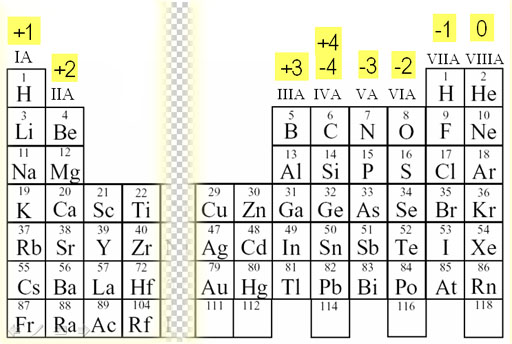 Ion Charge: the electrical charge that forms on an atom when it gains or loses electrons
- elements on the left side of the Periodic Table tend to form positive ions (cations)
- elements on the right side of the Periodic Table tend to form negative ions (anions)
- elements are arranged in columns or families by their similar ion charge(s)
- from the left side, elements begin with a positive charge that increases down the right of the period until it reaches a non-metal
- from the right side, elements begin with a negative charge that increases negatively to the left of the period until it reaches a metal
- the transition metals which have been positioned in the center (indicated on the chart by a solid checkered line) because most of them have more than one charge

- for metals, chemical reactivity increases as you move towards the left and down
- for non-metals, chemical reactivity increases as you move towards the right and up
ex. Potassium is more reactive than Beryllium because it is farther to the left and farther down. (Potassium also has much more electrons and is only one electron away from reaching a full valence shell.)
Ionization Energy: the energy needed to remove electrons from an atom; also referred to as ionization potential
- an atom with layers of inner electrons has stronger ionization energy because the inner electrons protect the outer electrons from the force of attraction the protons give off
ex.Chlorine has stronger ionization energy than Lithium

|
1 comments
|
Chemical Families
Mar 17, 2010
at
7:42 PM
Vertical columns are the groups or chemical families: Alkali Metals, Alkaline Earth Metals, Transition Metals, Halogens and Noble Gases
- Hydrogen is its own group
- elements in the same chemical family have similar physical and chemical properties.

Alkali Metals
- in group 1
- highly reactive and reactivity increases as you go down
- have only one electron in their outer shell and are lose that electron in ionic bonding with other elements
- react with non-metal
- usually have lower densities than other metals
- malleable, ductile, good conductors of heat and electricity
- have low melting points, below 200 °C
- soft and can be cut with a knife
Alkaline Earth Metals
- 2nd group
- have two electrons in their outer shell
- have low electronegativities
- less reactive than Alkali Metals but they will burn in air if heated. T
- react with water
- shiny
Transition Metals
- are the 38 elements in groups 3-12 of the periodic table
- are very hard
- have high melting and boiling points
- low ionization energies
- high electrical conductivity
- are malleable, they can be shaped and bent.
The Halogens
- in group 17 of the periodic table
- are highly reactive non-metals with strong and unpleasant odours
- will burn flesh and do not react well with water
- fluorine and chlorine are gases at room temperature, bromine is a liquid and iodine and astatine are solids.
Noble Gases
- group 18
- most stable and unreactive elements
- colourless, odourless gases at room temperature
- have high ionization energies and low boiling points
- Hydrogen is its own group
- elements in the same chemical family have similar physical and chemical properties.
Alkali Metals
- in group 1
- highly reactive and reactivity increases as you go down
- have only one electron in their outer shell and are lose that electron in ionic bonding with other elements
- react with non-metal
- usually have lower densities than other metals
- malleable, ductile, good conductors of heat and electricity
- have low melting points, below 200 °C
- soft and can be cut with a knife
Alkaline Earth Metals
- 2nd group
- have two electrons in their outer shell
- have low electronegativities
- less reactive than Alkali Metals but they will burn in air if heated. T
- react with water
- shiny
Transition Metals
- are the 38 elements in groups 3-12 of the periodic table
- are very hard
- have high melting and boiling points
- low ionization energies
- high electrical conductivity
- are malleable, they can be shaped and bent.
The Halogens
- in group 17 of the periodic table
- are highly reactive non-metals with strong and unpleasant odours
- will burn flesh and do not react well with water
- fluorine and chlorine are gases at room temperature, bromine is a liquid and iodine and astatine are solids.
Noble Gases
- group 18
- most stable and unreactive elements
- colourless, odourless gases at room temperature
- have high ionization energies and low boiling points
|
0
comments
|
Mendeleev's Periodic Table
Mar 15, 2010
at
7:53 PM
- Dmitri Mendeleev started organizing every known element and is credited with creating the first real periodic table of elements
- he sawa pattern and left spaces in the table for elements that were undiscovered
- there are 118 elements on the Periodic Table
- 7 periods and 18 columns
- metals on the left and non-metals are on the right
- elements with similar properties are in the same vertical column
- Atomic Number: Number of protons of the nucleus of each atom of an element
- Atomic Mass: Mass of an average atom of an element (tends to increase along with atomic number)
- Ion charge: Electric charge that forms on an atom when it gains or loses electrons

- he sawa pattern and left spaces in the table for elements that were undiscovered
- there are 118 elements on the Periodic Table
- 7 periods and 18 columns
- metals on the left and non-metals are on the right
- elements with similar properties are in the same vertical column
- Atomic Number: Number of protons of the nucleus of each atom of an element
- Atomic Mass: Mass of an average atom of an element (tends to increase along with atomic number)
- Ion charge: Electric charge that forms on an atom when it gains or loses electrons
|
0
comments
|
Where's Mr. Doktor?
Mar 11, 2010
at
11:44 AM
Mr. Doktor wasn't in class today and we had a sub. Instead of reviewing homework, we were assigned our group chemistry projects and started working on them.
Just a quick recap:
This is how two isotopes of hydrogen would look like. In essence, most of their properties are retained except for certain structural details.

Just a quick recap:
This is how two isotopes of hydrogen would look like. In essence, most of their properties are retained except for certain structural details.
|
0
comments
|